Most people don't have a time management problem.
They have an energy management problem.
That's why copying someone else's morning routine rarely works. A schedule that helps one person produce their best work can leave another feeling exhausted, distracted, or overwhelmed.
Productivity isn't about squeezing more tasks into your calendar. It's about knowing what to do, when to do it, and how your brain naturally performs throughout the day.
Recent research in chronobiology, cognitive psychology, and workplace performance consistently shows that our ability to focus, solve problems, and make decisions changes over the course of the day. Yet many people still plan every hour as if their energy stays constant.
It doesn't.
Instead of asking "How can I fit more into my day?" a better question is: "How can I schedule my day around the hours when my brain performs at its best?"
This guide explains exactly how to do that. You'll learn how to identify your peak productivity hours, schedule deep work for maximum focus, reduce decision fatigue, stop wasting high-energy hours on emails and meetings, and build a realistic daily schedule you can actually maintain.
Whether you're a student, entrepreneur, remote worker, or creative professional, the principles below are based on how the brain actually works — not on productivity myths.
Quick Answer
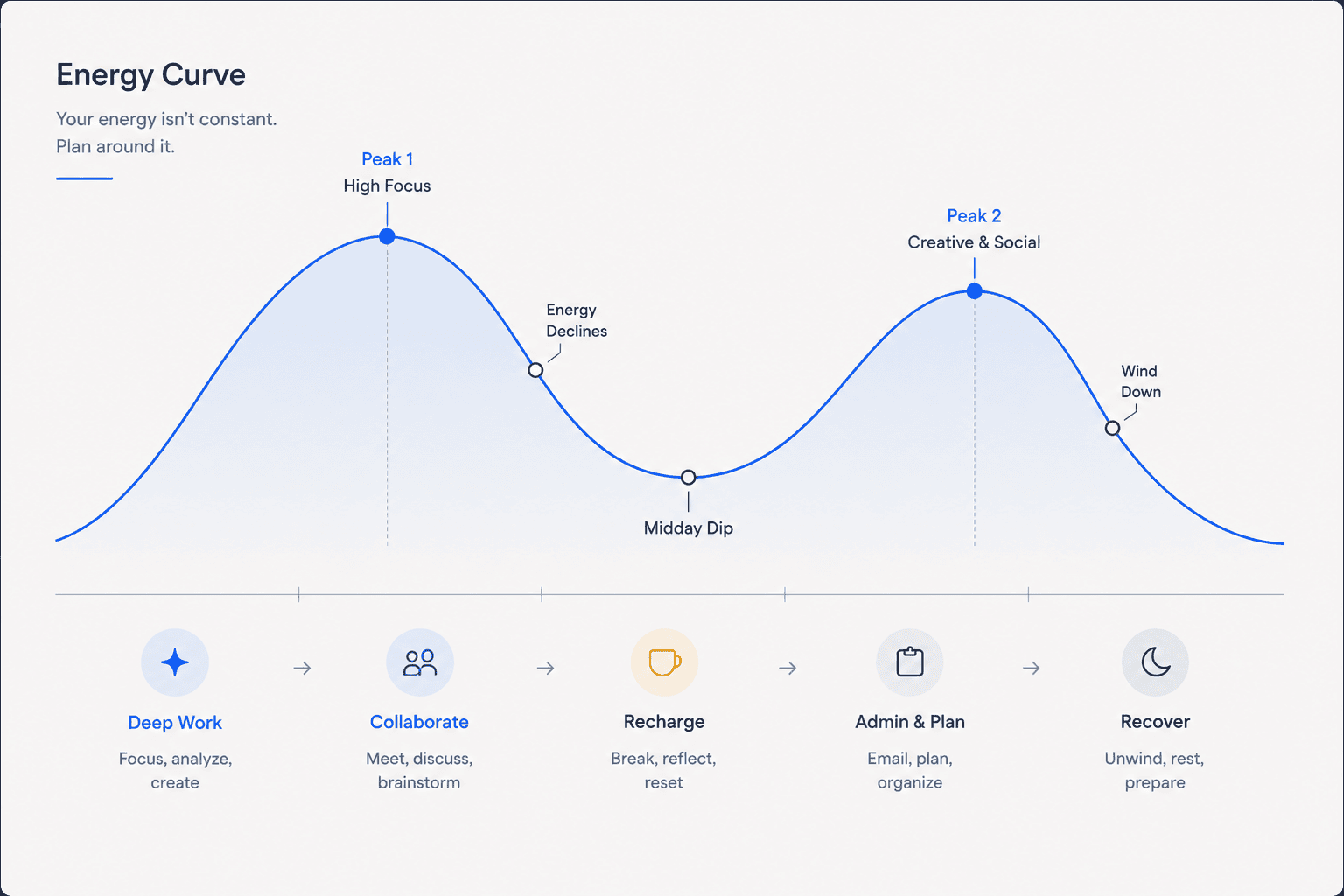
Your energy naturally rises and falls throughout the day.
The goal isn't to keep your energy high from morning to night. Instead, the key is to match the right type of work to the right moment.
When your energy is high, protect that time for deep, demanding work. As your energy dips, switch to lighter tasks that require less focus instead of fighting your natural rhythm.
Why Most Daily Schedules Fail
Open almost any productivity blog and you'll find advice like: wake up at 5 AM, start every day with meditation, work in 90-minute blocks, never check email before noon.
These ideas can help — but they aren't universal.
The biggest mistake people make is assuming that productivity is determined by time. In reality, it's determined by performance capacity.
Imagine asking two athletes to run their fastest race at midnight. One might perform well. The other might perform terribly. The difference isn't motivation. It's biology.
The same principle applies to knowledge work. Your brain isn't equally capable at every hour of the day. Attention fluctuates. Working memory changes. Decision-making quality rises and falls. Mental fatigue accumulates.
Trying to perform your hardest cognitive work during a low-energy period is like driving uphill with the parking brake engaged. You'll eventually reach the destination. You'll simply waste far more effort getting there.
Time Management vs. Energy Management
Traditional productivity advice focuses on protecting your calendar. Modern productivity focuses on protecting your brain.
Think of time as your daily budget. Think of energy as your spending power. Everyone receives roughly 24 hours. Nobody receives the same amount of usable mental energy at every hour.
That's why two people can spend the same eight hours working and produce completely different results. The difference usually isn't discipline. It's task alignment.
Highly productive people unconsciously do something most others don't: they perform their most valuable work during their highest-energy hours. Everything else gets scheduled around that.
The Science Behind Productivity
For decades, researchers believed productivity depended mostly on motivation. Today we know it's far more complex. Several biological systems influence how productive you feel during the day. The three most important are your circadian rhythm, your chronotype, and decision fatigue.
1. Circadian Rhythm
Your circadian rhythm is your body's internal 24-hour clock. It regulates alertness, hormones, body temperature, cognitive performance, and sleep pressure. These biological changes explain why concentration naturally peaks during certain hours and declines during others. In controlled studies, sustained attention tends to be lowest right after waking, climb toward a late-morning peak, dip in the early afternoon, and recover for a second, gentler peak later in the day.
2. Chronotype
Not everyone experiences peak performance at the same time. Some people naturally think better in the morning. Others consistently perform better in the afternoon or evening. Your chronotype — which is roughly half genetic — determines when your brain is most prepared for demanding work.
Trying to force yourself into someone else's schedule often creates unnecessary friction. Build a routine that matches your biology instead.
3. Decision Fatigue
Every decision consumes mental resources. Choosing what to wear. Replying to emails. Switching between projects. Checking notifications. Individually these actions seem insignificant. Collectively they reduce your ability to perform meaningful work later in the day. Research reviews describe decision fatigue as a measurable decline in decision quality after long stretches of repeated choices — which is why a morning full of small decisions leaves less capacity for the work that matters.
That's why successful schedules remove unnecessary decisions. The fewer choices your brain makes, the more energy remains for important thinking.
Find Your Peak Productivity Hours Before You Build a Schedule
You don't need the same schedule as a CEO, YouTuber, or entrepreneur. You need a schedule that matches your own cognitive rhythm.
Before deciding when to work, identify when you naturally perform your best.
Your Brain Doesn't Perform at the Same Level All Day
Most people assume productivity gradually declines from morning to night. Reality is more complex. Your focus, memory, creativity, and decision-making abilities fluctuate throughout the day because of several biological factors, including your circadian rhythm, sleep quality, nutrition, movement, and stress.
This means your "best working hours" are unique to you. Instead of forcing yourself into an idealized schedule, spend one week observing your energy. Ask yourself three simple questions every two hours: How focused do I feel? How mentally demanding could my next task be? Do I feel energized or mentally drained?
Create Your Personal Energy Map
Think of your day as three different zones rather than a long list of hours. This approach is known as energy-based scheduling — one of the simplest ways to get more from the same hours.
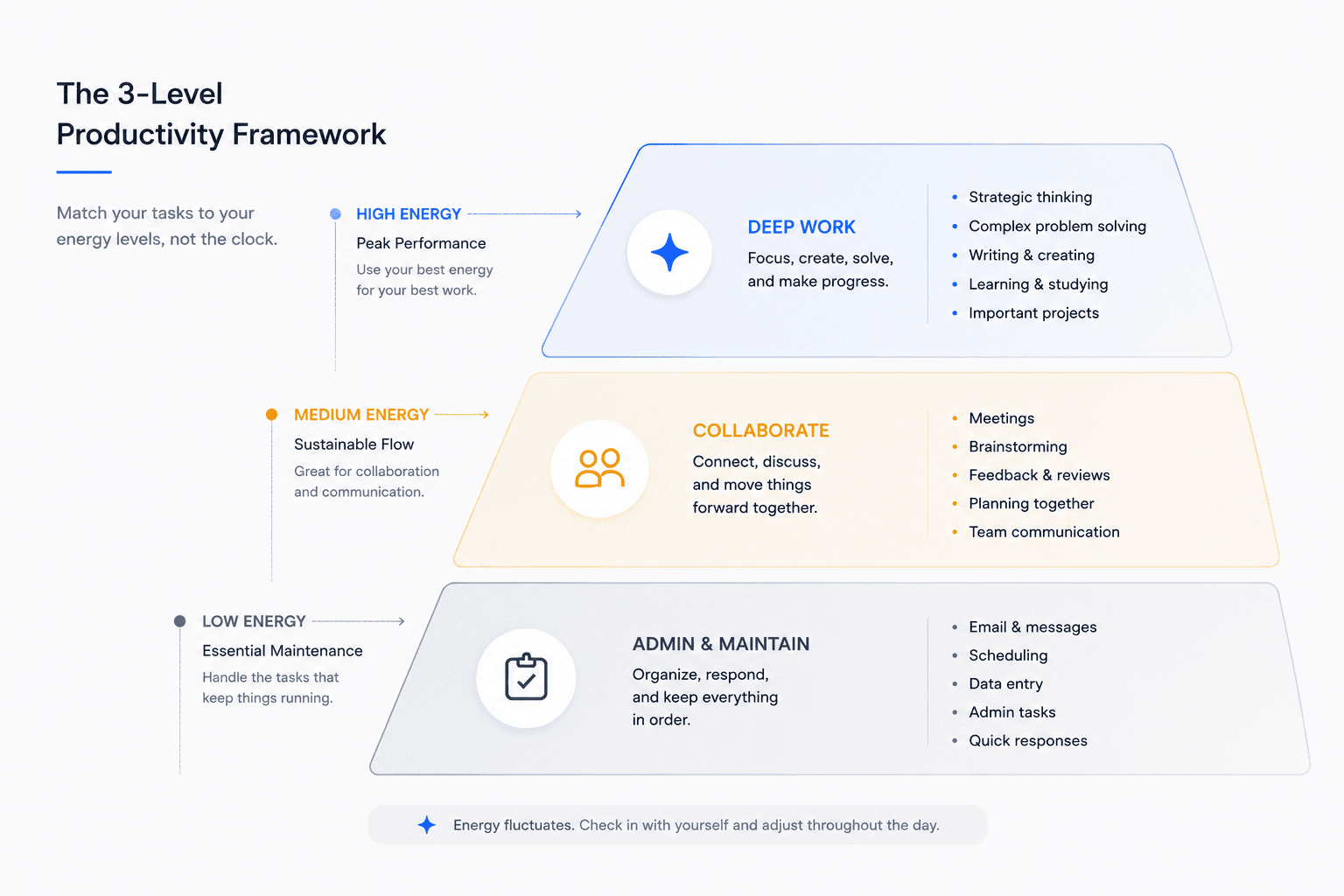
High Energy Zone
This is when your brain performs at its highest capacity. During this period you should protect your attention at all costs. Ideal tasks include writing, coding, designing, strategic planning, problem solving, studying, learning difficult concepts, and data analysis.
If a task requires uninterrupted thinking, it belongs here. Avoid checking email. Avoid meetings. Avoid social media. Every interruption during your peak hours carries a hidden cost, because your brain needs time to regain deep focus.
Medium Energy Zone
Your focus is still good, but you're no longer operating at maximum capacity. This is the perfect time for collaborative work: team meetings, client calls, brainstorming, reviewing documents, giving feedback, planning tomorrow, and research. These activities benefit from attention but don't require sustained deep concentration.
Low Energy Zone
Every productive day includes periods where your brain simply wants to conserve energy. Don't fight them. Use them wisely. Instead of forcing yourself into difficult work, schedule low-impact tasks such as email, calendar management, expense reports, organizing files, updating documents, responding to messages, and administrative work.
Many people feel guilty during these hours. They shouldn't. Productivity isn't about feeling motivated every minute. It's about assigning the right work to the right energy level.
Schedule Your Most Important Work First
A common mistake is filling the morning with meetings, email, and notifications before starting meaningful work. By the time the important task begins, your best mental energy has already been spent.
Instead, reverse the order. Ask yourself one question every morning: If I could complete only one task today, what would create the biggest impact? Schedule that task first.
This idea is often called the Most Important Task (MIT) principle. When combined with your peak energy hours, it becomes dramatically more effective. For example:
- Email → Meetings → Deep Work
- Deep Work → Meetings → Email
The tasks are the same. Only the order changes. The results usually change dramatically.
Use Time Blocking — But Don't Make It Too Rigid
Time blocking is one of the most recommended productivity methods. However, many people misunderstand how it should work. A calendar filled with perfectly color-coded one-hour blocks looks productive. It often isn't.
Life is unpredictable. Meetings run long. Phone calls happen. Unexpected requests appear. If your schedule leaves no flexibility, one interruption can derail the entire day.
Instead of planning every minute, block your calendar by purpose:
| Time | Focus |
|---|---|
| 8:30–10:30 AM | Deep work |
| 10:30–11:00 AM | Break & email |
| 11:00 AM–12:00 PM | Meetings |
| 1:00–3:00 PM | Project work |
| 3:00–4:00 PM | Admin tasks |
| 4:00–4:30 PM | Plan tomorrow |
Notice that each block represents a type of work rather than a detailed task list. This approach gives you structure without sacrificing flexibility. (For the layer above the day, see how to do weekly planning.)
Protect Your Deep Work Sessions
Deep work is where high-value results are created. Unfortunately, it's also the easiest type of work to interrupt. Research consistently shows that frequent context switching increases cognitive load and reduces efficiency. Every time you switch from writing to Slack, then to email, then back to writing, your brain needs time to rebuild context — an effect researchers call attention residue. Those small interruptions accumulate throughout the day.
During deep work sessions: turn off notifications, close unnecessary browser tabs, put your phone away, work on one project only, and let colleagues know you're unavailable.
Batch Similar Tasks Together
Your brain pays a small cost every time it changes contexts. Reading email. Writing a proposal. Joining a meeting. Reviewing data. Each transition requires mental adjustment.
Instead of constantly switching, group similar activities together. Answer all emails twice a day. Schedule meetings back-to-back. Review documents in one session. Handle administrative work at the end of the day.
This technique, known as task batching, reduces unnecessary decision-making and helps preserve mental energy for more important work.
Stop Chasing the Perfect Schedule
Many productivity systems fail because they assume every day will go according to plan. It won't.
The goal isn't to build a perfect schedule. The goal is to create a schedule that adapts when life doesn't go perfectly. A productive day isn't one where every box gets checked. It's one where your highest-energy hours are spent on your highest-value work. Everything else is optimization. (This is also what keeps a system alive on bad days — more on that in does missing one day ruin your streak?)
A Science-Backed Daily Schedule Template
There isn't a single "perfect" daily schedule. The most productive schedule is the one that aligns your most demanding work with your highest-energy hours. Use this framework as a starting point, then shift the hours to fit your own rhythm.
| Time | Focus |
|---|---|
| 7:00–8:00 AM | Wake up, light movement, breakfast |
| 8:00–10:00 AM | Deep work (Most Important Task) |
| 10:00–10:30 AM | Short break |
| 10:30 AM–12:00 PM | Continue focused work |
| 12:00–1:00 PM | Lunch and a walk |
| 1:00–3:00 PM | Meetings and collaboration |
| 3:00–4:00 PM | Administrative tasks |
| 4:00–4:30 PM | Review progress and plan tomorrow |
| Evening | Exercise, hobbies, recovery, sleep prep |
Remember, the exact hours matter far less than the order. Protect your best energy. Everything else fits around it.
Sample Schedule for Remote Workers
Working from home creates flexibility. It also creates distractions. Without a clear structure, your workday can become a series of interruptions. A better approach is to separate your day into three distinct phases.
Phase 1: Create. Spend your first high-energy block producing valuable work. Avoid Slack, email, and meetings.
Phase 2: Collaborate. Use your moderate-energy hours for communication — meetings, calls, team discussions, and feedback sessions.
Phase 3: Maintain. End the day with lighter work — inbox zero, documentation, planning tomorrow, and updating project boards.
This simple structure reduces context switching while making every hour more intentional.
Sample Schedule for Students
Students often spend too much time studying when they're mentally exhausted. Instead of studying longer, study smarter. A productive study day usually follows this order: learn difficult concepts during peak focus, complete assignments during medium-energy periods, and review notes and organize materials during low-energy hours.
Even two focused study sessions are often more effective than six distracted hours.
Sample Schedule for Entrepreneurs
Entrepreneurs rarely struggle because they have too much work. They struggle because everything feels equally important. A better system is to divide work into three categories.
Growth — activities that directly increase revenue: product development, sales, marketing strategy, partnerships. Always schedule these first.
Operations — tasks that keep the business running: meetings, hiring, customer support, financial reviews. Schedule these after your most important work.
Maintenance — everything else: invoices, email, administration. These tasks matter, but they shouldn't consume your highest-energy hours.
Productivity Mistakes That Waste Your Best Hours
Even with a great schedule, a few habits can quietly reduce your productivity.
Starting the day with email. Email feels productive because you're responding to requests. In reality, you're allowing other people's priorities to shape your day. Whenever possible, finish one meaningful task before opening your inbox.
Scheduling too many meetings. Meetings rarely require your highest level of thinking. Reserve your best hours for creating, not discussing, and batch meetings together when you can.
Multitasking. Multitasking doesn't help you finish more work. It usually means you're switching attention more frequently. Single-tasking consistently produces higher-quality results.
Ignoring recovery. Your brain isn't designed to maintain peak focus for eight straight hours. Breaks aren't wasted time — they're part of the productivity process. A short walk, stretching, or simply stepping away from your screen can help restore attention.
How Ducivo Helps You Schedule Around Your Energy
Knowing your peak hours is one thing.
Protecting them every day is much harder.
Meetings get moved. Priorities change. New tasks appear. Before long, the hours you wanted to reserve for meaningful work have been filled with everything else.
That's exactly the problem Ducivo was built to solve.
Instead of asking you to build the perfect schedule from scratch, Ducivo starts with your natural rhythm.
During onboarding, it learns just two things:
- Your usual sleep window
- The hours when you naturally do your best work
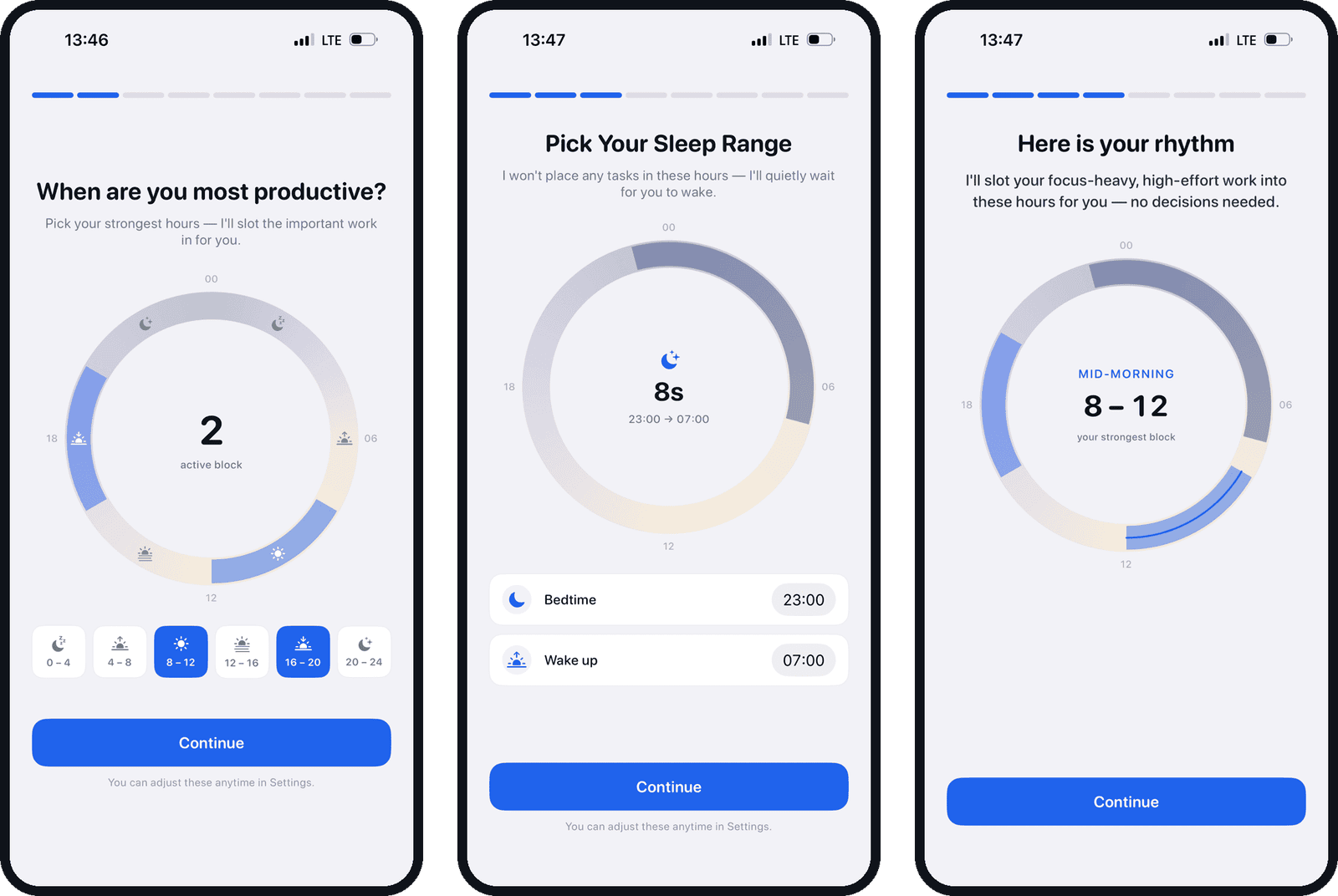
From there, your schedule is built around your energy — not around an empty calendar.
Simply describe what you need to do in plain language. Ducivo automatically organizes your tasks into structured time blocks that fit your day, placing deep work during your highest-energy hours and lighter work when your focus naturally declines.
Unlike traditional planners that expect you to micromanage every hour, Ducivo adapts to the rhythm you've already established.
When your peak focus window arrives, Focus Mode helps you stay on your most important task by reducing distractions and keeping your attention where it matters most.
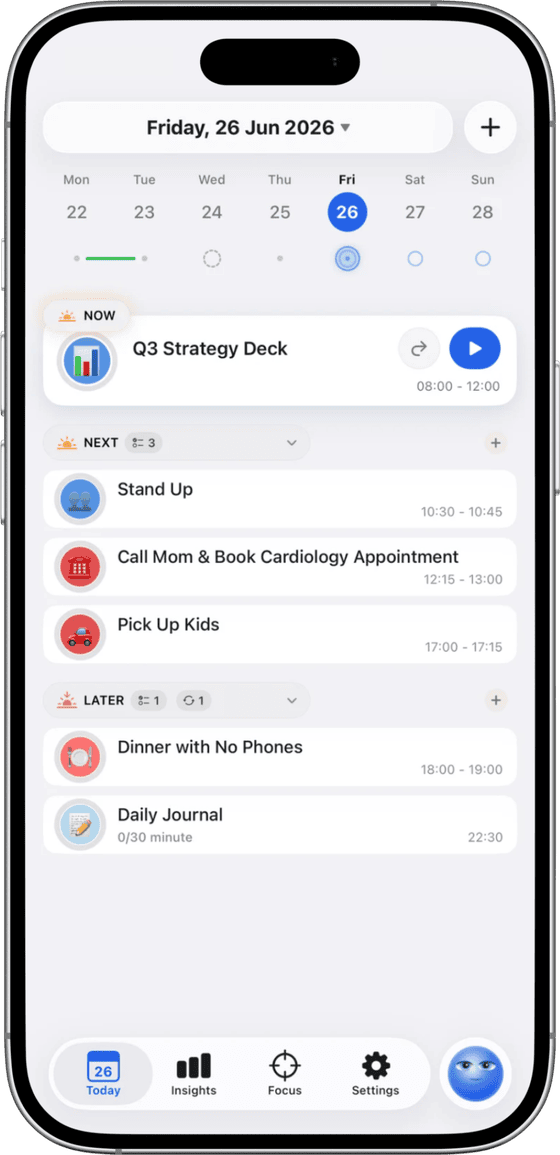
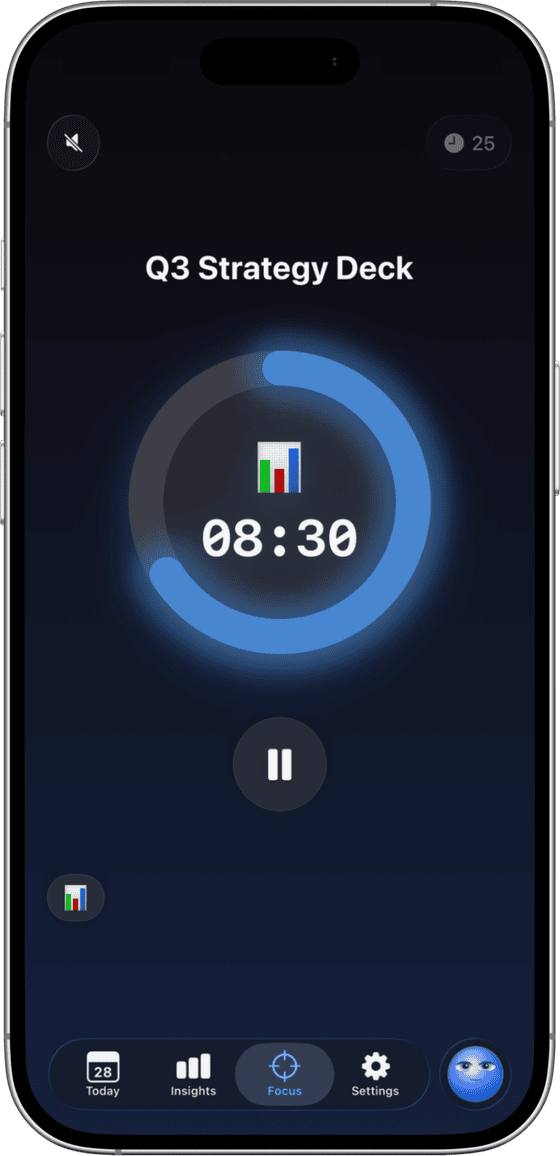
The result is a schedule that feels natural instead of forced.
You don't have to redesign your day every morning or constantly rearrange your calendar when plans change. Your schedule stays aligned with the way you actually work, making it easier to protect your best hours without thinking about it.
If you're ready to stop planning around the clock and start planning around your energy, Ducivo makes that transition effortless.
Start scheduling around your energy today.

Your 7-Day Productivity Challenge
Changing your schedule overnight rarely works. Instead, experiment for one week.
- Day 1 — Track your energy every two hours.
- Day 2 — Identify your peak focus window.
- Day 3 — Move your most important task into that window.
- Day 4 — Batch emails into one or two sessions.
- Day 5 — Protect one uninterrupted deep-work block.
- Day 6 — Reduce unnecessary meetings.
- Day 7 — Review what worked and adjust your schedule.
Small improvements repeated consistently create lasting productivity gains — the same way habits form over time.
Key Takeaways
- Your calendar should follow your energy — not the other way around.
- Deep work deserves your highest-energy hours.
- Meetings and email belong later in the day whenever possible.
- Task batching reduces mental fatigue.
- Productivity comes from better decisions, not longer hours.
- Consistency beats perfection.
The goal isn't to become busy. The goal is to make your best hours count.
Related Reading
- How to do weekly planning — the layer above your daily schedule.
- Does missing one day ruin your streak? — building a system that survives bad days.
- How long does it take to build a habit? — turning a schedule into a routine.
- The best planning apps of 2026 — tools that schedule around your energy.
Final Thoughts
Most productivity advice focuses on squeezing more into your calendar. The better question is whether you're protecting the hours that matter most.
When you align your schedule with your natural energy patterns, work becomes more sustainable, decision-making improves, and meaningful progress feels easier. Your calendar isn't just a list of appointments. It's a reflection of what deserves your best attention. Design it intentionally.
References
- Valdez, P. (2019). Circadian Rhythms in Attention. Yale Journal of Biology and Medicine.
- Monk, T. H. (2005). The post-lunch dip in performance. Clinics in Sports Medicine.
- Facer-Childs, E. R., et al. Time of day and chronotype in the assessment of cognitive functions. PMC / NIH.
- Roenneberg, T., et al. (2006). Social jetlag: misalignment of biological and social time. Chronobiology International.
- Pignatiello, G. A., Martin, R. J., & Hickman, R. L. (2020). Decision fatigue: A conceptual analysis. Journal of Health Psychology.
- Leroy, S. (2009). Why is it so hard to do my work? The challenge of attention residue. Organizational Behavior and Human Decision Processes.
- Mark, G., Gudith, D., & Klocke, U. (2008). The cost of interrupted work: more speed and stress. CHI '08.
- American Psychological Association. Multitasking: Switching costs.