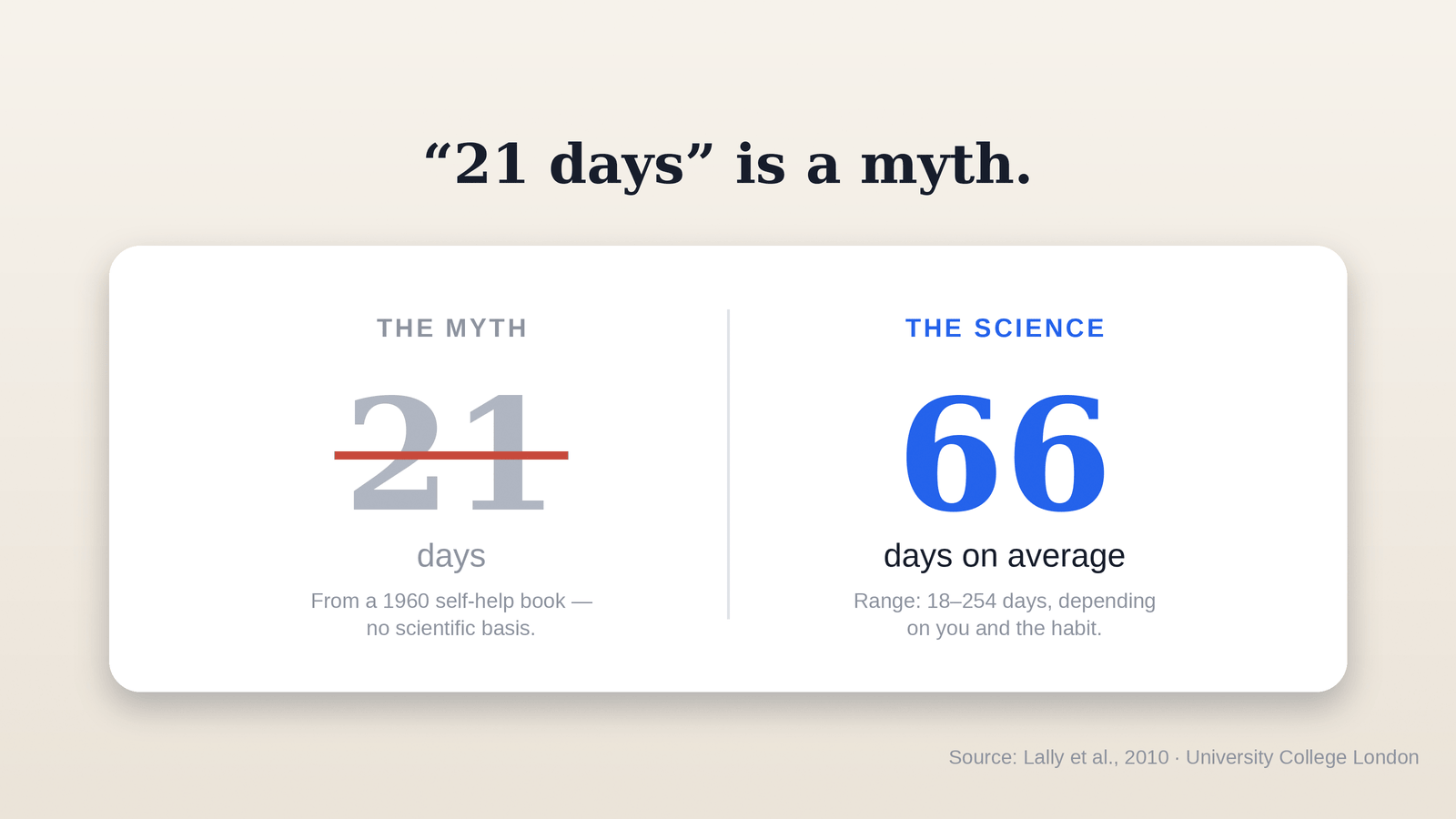
Quick answer — A habit takes an average of 66 days to become automatic (Lally et al., 2010, University College London). Depending on the person and how complex the behavior is, it ranges from 18 to 254 days. The popular "21-day rule" has no scientific basis — it traces back to a plastic surgeon's observation in 1960. So there's no reason to blame yourself when it "didn't stick in 21 days." It simply takes longer.
Where did the "21-day" myth come from?
In 1960, plastic surgeon Maxwell Maltz observed that it took his patients "a minimum of about 21 days" to get used to their new appearance. That personal observation got repeated so often over the years that it hardened into what sounds like a scientific law. But Maltz said "a minimum" — a floor, not an average. Pop culture dropped that detail.
So what does the science say?
The most-cited study is Lally et al. (2010). Participants tracked a new daily behavior for 12 weeks. The result: a behavior took an average of 66 days to feel automatic. But the real story was the spread — simple habits (drinking a glass of water with a meal) settled in as few as 18 days, while complex ones (50 sit-ups before breakfast) stretched toward 254.
The takeaway is clear: there's no single answer to "how many days?" The harder the habit, the longer it takes. That's not a flaw — it's normal.
Why do most people quit too early?
Because they start with the wrong timeline. Someone expecting "21 days" hits day 22 still struggling, concludes "I guess this isn't for me," and quits. In reality they were squarely inside the normal range. Resetting the expectation to 66 days — more for harder habits — removes the single biggest reason people give up.
And if you do miss a day along the way, it matters far less than you think — see does missing one day ruin your streak?
How to shorten the timeline: lower the bar
Whether a habit sticks depends on how many times you repeat it. So the move isn't "grind harder for longer," it's "keep it small enough to do every day." Define the smallest, easiest version of the habit — so small you can do it even on a bad day. Repetition means consistency, and consistency is what makes a habit stick.
That's why in Ducivo (iOS) habits live on their own track, and the goal isn't a perfect streak — it's the repetition itself. (The three-tier approach, where you define a low-energy "baseline" version of each habit, is on Ducivo's roadmap and coming soon.)
Want to wrap a weekly routine around this? Read how to do weekly planning. And for the day itself, see the most productive way to schedule your day.
Source: Lally et al. (2010), European Journal of Social Psychology.